

David Warner guides Australia home against an inspired Afghanistan
- The Nightwatchman
- Jun 2, 2019
- 5 min read

The domination of the big boys continues. Australia defeated Afghanistan almost as simply as New Zealand dispatched Sri Lanka earlier in the day in Cardiff. They won by seven wickets with 15.1 overs to spare and once again the pace bowlers prevailed.
Afghanistan fought more effectively than Sri Lanka or Pakistan at Trent Bridge, where they were thrashed by West Indies on Friday, but their total of 207 was never going to be enough to trouble Australia on a benign, evenly grassed surface. Even for the romantics in the crowd, 90% of whom were cheering every Afghanistan run, it was not enough.
Given the appalling nature of the start of the Afghanistan innings it was quite an achievement to pass 200. They have the most engaging of opening pairs. The tubby little wicketkeeper, Mohammad Shahzad, is a sweet timer of a ball, who is no more enthusiastic about the prospect of a quick single than Chris Gayle. His partner, Hazratullah Zazai, is a tall, muscular left-hander who can pepper the leg-side boundary on his day. But this was not his day. Nor was it Shahzad’s.
In the space of five deliveries they were dismissed for ducks, Shahzad bowled off his pads by Mitchell Starc, Hazratullah caught behind wafting at Patrick Cummins.
It was always going to be a struggle from five for two. Rahmat Shah and Hashmatullah Shahidi added a steady 51 whereupon Australia’s leg-spinner, Adam Zampa, intervened via a stumping and a good catch at short extra-cover by Steve Smith, whose deft fielding then caused the run-out of Mohammed Nabi.
By now Afghanistan had slumped to 77 for five and there seemed a good chance the floodlights would be redundant.
Thanks to a resolute, often harum-scarum partnership of 83 between Gulbadin Naib and Najibullah Zadran, who produced the solitary half-century of the innings, and a typically belligerent 27 from Rashid Khan – an innings of 11 balls during which he took 20 runs from a Marcus Stoinis over – Afghanistan flirted with respectability. However, there were almost 12 overs available when their last wicket fell.
This was a most satisfactory workout for the bowlers. Starc, who has played remarkably little ODI cricket since the last World Cup, when he was virtually unplayable, bowled his usual full length at the start and was rewarded with Shahzad’s wicket. Cummins was quick, rhythmical and on target. These are Aaron Finch’s trump cards. Once the ball refrained from swinging – not that there was ever much movement in the air – Australia reverted to a much shorter length.
Advertisement
This confirmed a common tactic among the pace bowlers in the tournament so far. Since the white ball seldom moves in the air or off the surface, bowlers have reverted to exploring the middle of the pitch. The ability to bowl well-directed bouncers becomes a more effective mode of attack; this requires more skill than us non-fast bowlers might imagine. If the ball is hip high it can be easily dispatched; if above head high it is a wide. But when the ball is directed at the batsman’s chin there are problems for all bar the best players.
So there have been an increasing number of skied catches from top-edged hooks in the first few matches of this tournament – as well as a few sixes.
Currently, this is the paceman’s response, which may be encouraged by the fact the square boundaries of so many English grounds are so much longer than the straight ones. Cummins and Stoinis kept the square-leg umpires on the alert since they had to decide whether the ball was passing the batsmen above head height.
The Afghanistan bowlers lacked the pace to adopt this type of attack during Australia’s tranquil run chase. Finch was forthright from the start in his no-nonsense muscular manner. His bat looked good and sounded better. When Rashid Khan, the obvious dangerman, was introduced he propelled a long-hop that Finch dispatched towards the Severn Bridge, the biggest of his four sixes. In an opening partnership of 96 with David Warner, Finch’s contribution was 66 from 49 balls. y contrast, Warner was careworn by his standards, but this was appropriate given the state of the game. Timing was elusive, but that did not matter too much. He looked as if he was enjoying playing the gnarled innings of an old pro, especially against his two teammates from Hyderabad (Rashid and Nabi).
His half-century took 74 balls, after which the ball found the middle of his bat more frequently. He finished with an impressively measured 89 not out. Warner was the man of the match and admitted: “There were a few extra nerves being back in the camp but I was more relaxed once Finchy started going. It was great to get out there again.”
There were a few pantomime boos for Warner, but his reception was no more hostile than that given to the ugly sisters at the Bristol Hippodrome last Christmas. Oddly, Smith’s arrival at the crease seemed to attract more vitriol. This did not prevent them guiding Australia to the most straightforward of victories, even if Smith did fall with three runs to win, another gentle step in their rehabilitation.
THE STAR

A slow and steady David Warner was undoubtedly the most impressive of the Australians. Coming into the match on the back of some impressive form, Warner ensured Australia made light work of the Afghani's respectable total of 207. His 89 not out came off 114 at a strike rate of 78.07, well below his career strike rate of 96.09, but it was the perfect innings from arguably the Australian's best ODI batsman to begin their World Cup title defence. THE MOMENT

Second ball of the innings Mitchell Starc signalled to the cricketing world that he could still bowl serious late in-swing as Afghanistan's opening batsman Mohammad Shahzad lost his off stump. It was the only wicket of the day for Starc, but it was the perfect message to send to the other eight sides the Australian's will come up against. THE FAILURE
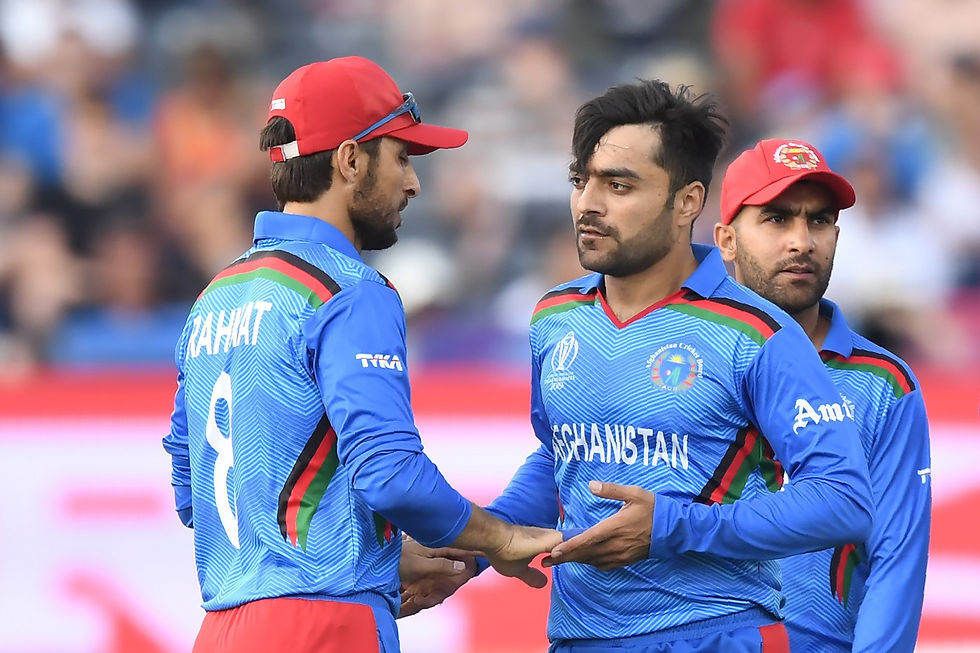
Rashid Khan failed to live up to the hype, finishing with 1 for 52 off 8 expensive overs. A total of 207 was enough to give the Afghani's a chance of making their own statement, even in defeat, and Khan needed to be better, but he failed to land them as we know he can and Australia made hay while the sun shone.
WHAT NEXT – Afghanistan will likely go into their fixture against Sri Lanka on Tuesday as favourites, whilst Australia take on the West Indies on Thursday.
TONIGHT – South Africa will try and bounce back from their defeat against England when they take on Bangladesh in their first match of the World Cup


Comments